Storytelling
Book / Produced by partner of TOW
Once upon a time, not so very long ago, stories were counted among the most treasured possessions in our homes. To have known the stories of a family, of a people, was to have held the key to the very heart of its being. To have spoken those stories in wise and timely ways was to have fulfilled a calling esteemed by both paupers and kings. And to have heard those stories, to have truly listened to them with heart and mind, was to have participated in the oldest and perhaps most intimate of the human arts—storytelling.
The tradition of oral storytelling is common to every culture the world over. Since the dawn of language, people have used the imagery and metaphor of stories to express their experience of life. We make stories as naturally as we make breakfast, or make love, says author Rudy Wiebe in his introduction to The Story-Makers. Through stories we make sense of that which we cannot face head on. Stories (by a means that cannot be fully explained) reach levels of the subconscious inaccessible to rational words alone (Bausch, p. 17). Stories are, simply and profoundly, the language of the soul.
God created us to story together. The unfolding drama of the Creator’s love for us opens with three engaging words: “In the beginning” (Genesis 1:1). The stories of the Old Testament chronicle the lives of ordinary people who discover, daily, that spirituality is rooted in the earthy events of their lives (Isaiah 25:6-9). God reaches out to us through stories. The new covenant was revealed through a Son who “has spoken to us” (Hebrews 1:2), “who unmasked eternal truths by telling homely stories of Palestinian life” (Bausch, p. 21). To return, as Christ calls us, to a childlike openness to mystery and love (Matthew 18:3), we must restore and nurture a respect for the power of story and the place of storytelling in our lives.
The Story Stone
There is a story told among the Seneca people (in what is now New York State) of a boy who lived with his father, mother and sister on the edge of a great forest. Life was good for the people of the village. The men hunted, the women gathered, and the land provided everything they needed. But they were not quite human yet—they had no stories (Moore, p. 118).
One day, while hunting, the boy hears a large stone call out to him. The stone invites the boy to listen to a story but first requires a small gift. The boy gives to the stone the bird that he has caught, then sits in awe as the stone speaks this strange new thing. One by one, the other members of the family discover the boy’s secret, each learning to give something in exchange for a story. Together the family decides to bring their stories back to the village. At once, upon hearing the tales, the loose gathering of people becomes a community. The stories told become their stories, binding the people in ways that the common need of food and shelter never had. Then one day the stone announces that it will speak no more. The boy cries out, “That cannot be. I do not want to live without your stories!” To which the stone replies, “You are now the storyteller. As long as one person remembers these stories, you will never be without them.”
For some people, this ancient art of storytelling is as fresh and present as the morning. These are the friends, family members and strangers we all recognize as natural storytellers. With the gift of gab and a knack for just the right story at just the right moment, these characters are ready and willing to entertain, instruct and encourage us with their tales. But, are we always as eager to listen?
Dramatic changes in society and technology have, with startling speed, usurped the role of the storyteller as the “mirror and memory” of our lives (Yolen, p. 35). No longer do we look to our elders, or our story-keepers, for tales of heroes and heroines to model courage and morality. Instead, we grope for glimpses of celebrities whose private lives we love to covet (and criticize). Where once there was an extended family of grandparents, adults and children living close to one another, sharing in a common folklore that told us who we were and how we were to live, there is now the nuclear or single-parent family often living a great distance from ancestral roots. For many of us the old stories and myths that once characterized our culture are now available only if we go searching for them on the library shelves.
Before television took over the place of honor in our homes, families used to turn to each other for telling, listening and remembering (Deut. 6:5-7; Rosenbluth, p. 2). Although we acknowledge readily that children love stories, we are only now beginning to recognize that as adults we need more than anecdotes in sermons or passing conversation (a kind of “fast food” for the soul). We are coming to understand that without storytelling we will, like the people of the Seneca legend, be living less than human lives. In key areas of knowledge—philosophy and ethics, anthropology and psychology, education and communication—as well as in preaching and theology, an appreciation of story and the importance of storytelling is coming back into its own.
A Living Art
While it may be argued that there are stories everywhere around us (newspapers, books, television, film, video), none of these media fully embodies the art of storytelling. Storytelling is essentially an interactive experience. It requires an encounter between both storyteller and the story listener. It is a living, intimate and wonderfully unpredictable art. Stories may begin “a long time ago,” but because they are heard and felt in the present, they always end with “right now” (Shea, p. 8).
A good storyteller is willing to be vulnerable, to be in the presence of the audience, to sense the mood of the listener and to respect the free will of each person to take what is needed from the story. This is the unique gift of respected elders among many aboriginal communities. When asked a direct question, the elders answer indirectly, with a story. The listener is left to reflect upon the possible meaning(s) of the story—an insight that often does not come for years (Cruikshank, p. 2).
The parables of Jesus reflect this same wisdom. Jesus knew that his listeners were at many different stages on their spiritual journeys. Rather than engage the crowd in an intellectual debate, he simply told stories (Matthew 13:34). Those who had eyes to see and ears to hear understood (Matthew 13:16). The Old Testament prophet Nathan was also gifted of God in telling the exact story needed to strike at the core of the matter. Instead of confronting David directly with his sins of adultery and murder, Nathan told a story: “There were two men in a certain town, one rich and the other poor” (2 Samuel 12:1). David needed nothing more than the story to be enraged by the injustice revealed. The Scottish bard David Campbell says that stories are always the shortest distance to the truth.
Beginning to Tell
With models of great storytellers in Scripture and history, you may feel somewhat intimidated to follow in their footsteps. Like every good art, storytelling has masters to be admired, but at the heart storytelling has one simple rule: respect the story and your listener. Whether your story is a lively tale of fun and good humor or a mythic quest of courage, give the story all that it needs to be alive in the moment of sharing. See yourself as a finely tuned instrument upon which the story is played.
Choose to share only those stories that move you (to tears, laughter, wonder); then get to know the story inside out. Reflect carefully on the stages of the story: How does it invite the listener into the time of the story? How does it build? Where are the contemplative pauses? Does the story conclude with a sense of wholeness? Imagine the characters and the setting in your mind’s eye. Choose (and pace) your language thoughtfully to give your listeners select sensory clues to re-create the story images in their own minds. Enjoy this as the greatest reward of the storyteller: the knowledge that within each imagination lies a wholly unique version of the story; no two imaginings are ever entirely alike. Television cannot hold a candle to that.
Draw upon the many resources available to storytellers today. Subscribe to a national storytelling journal (addresses of two are noted in References and Resources). Associations of storytellers can provide a calendar of storytelling festivals, conferences and workshops. Immerse yourself in collections of folklore, myth and literary tales. Read stories and Scripture aloud (even if you are alone) to remind yourself that language was meant to be spoken.
Finally, be prepared to learn as much about yourself as you will about the stories. You will begin to see, hear and feel stories everywhere about you. You may begin to understand, as John Shea suggests, that ministry begins at the intersection between God and his people, as revealed in their stories. Be inspired along your journey by the words of the late Angela Sydney, beloved storyteller of the Tagish people in the southern Yukon, who once said, “I have no money to leave my grandchildren, my stories are my wealth” (Cruikshank, p. 36).
» See also: Conversation
» See also: Fairy Tales
» See also: Grandparenting
» See also: Movies
» See also: Preaching
» See also: Teaching
» See also: Television
References and Resources
W. J. Bausch, Storytelling: Imagination and Faith (Mystic, Conn.: Twenty-Third Publications, 1984); J. Cruikshank, Life Lived like a Story: Life Stories of Three Yukon Elders (Lincoln: University of Nebraska Press, 1990); C. P. Estes, The Gift of Story: A Wise Tale About What Is Enough (New York: Ballantine, 1993); D. Kossoff, Bible Stories (London: William Collins Sons, 1968); R. Moore, Awakening the Hidden Storyteller: How to Build a Storytelling Tradition in Your Family (Boston: Shambhala Publications, 1991); A. Pellowski, World of Storytelling (New York: Bowker, 1977); V. Rosenbluth, Keeping Family Stories Alive: A Creative Guide to Taping Your Family Life and Lore (Point Roberts, Wash.: Hartley & Marks, 1990); J. Shea, Stories of God: An Unauthorized Biography (Chicago: Thomas More, 1978); R. Wiebe, The Story-Makers (Toronto: MacMillan, 1970); J. Yolen, Touch Magic: Fantasy, Faerie and Folklore in the Literature of Childhood (New York: Philomel Books, 1981). Appleseed, Journal of the Storytellers’ School of Toronto (412A College St., Toronto, Ontario, Canada M5T 1T3); Storytelling Magazine, Journal of the National Storytelling Association (P.O. Box 309, Jonesborough, TN 37659).
—Susan Catherine Klassen





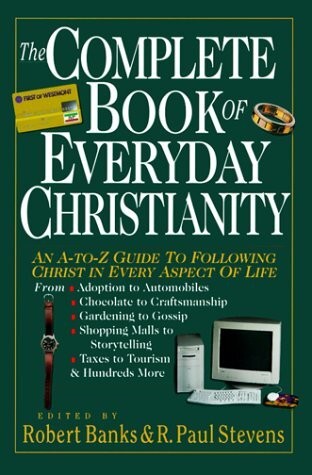
The authors Robert Banks and R. Paul Stevens have partnered with The Theology of Work Project to offer The Complete Book of Everyday Christianity in its entirety here. All rights reserved.
This resource was originally published in 1997, and the text has not been updated.